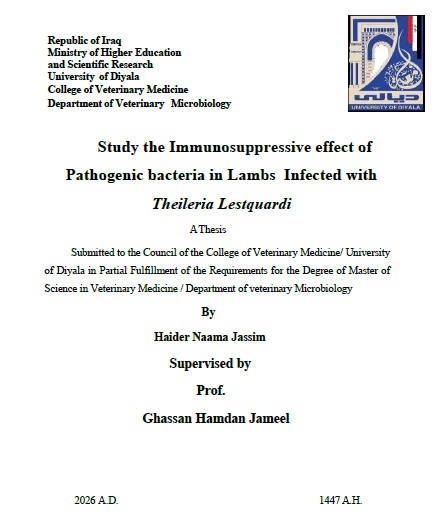
Theileriosis is a major tick-borne disease affecting ruminants and is associated with considerable economic losses in the livestock industry worldwide. The present study aimed to investigate Theileria spp. infection in lambs in Diyala Province using serological, molecular, hematological, and bacteriological approaches, with particular emphasis on associated secondary bacterial infections and immune responses.
A total of 100 lambs aged 3–9 months were included in this study, comprising 50 clinically infected animals showing signs such as muscle weakness, diarrhea, and coughing, in addition to 50 apparently healthy lambs serving as controls. Blood samples were collected from all animals, along with oral and nasal swabs for bacteriological examination.
Serological evaluation was performed to measure immunoglobulin G (IgG) and interferon-gamma (IFN-γ) levels using the ELISA technique, while molecular detection of Theileria parasites was conducted using polymerase chain reaction (PCR). Hematological parameters were assessed through complete blood count (CBC). Bacteriological culture was carried out to identify secondary bacterial pathogens and determine their antimicrobial susceptibility patterns in vitro.
The results demonstrated significantly elevated levels of IgG and IFN-γ in infected lambs compared with controls (p ≤ 0.001). Molecular analysis confirmed a high prevalence of Theileria infection, with PCR detecting Theileria lestoquardi in a substantial proportion of examined samples. Bacteriological findings revealed a high incidence of secondary bacterial infections, with the most frequently isolated organisms including Klebsiella aerogenes, Klebsiella
pneumoniae, Escherichia coli, Pasteurella multocida, Pseudomonas aeruginosa, Vibrio fluvialis, Klebsiella oxytoca, and Enterobacter cloacae complex.
Hematological analysis indicated significant dysregulation characterized by eosinophilia, relative neutropenia, and basophilia in infected animals. Antimicrobial susceptibility testing using the Kirby–Bauer method revealed variable resistance patterns among isolates, with an overall resistance rate of approximately 30%. Ciprofloxacin, gentamicin, and meropenem demonstrated the highest efficacy against the recovered bacterial isolates.
In conclusion, Theileria infection in lambs is associated with marked immunological and hematological alterations and is frequently complicated by secondary bacterial infections. Early diagnosis and appropriate antimicrobial selection are essential for improving therapeutic outcomes and reducing economic losses.